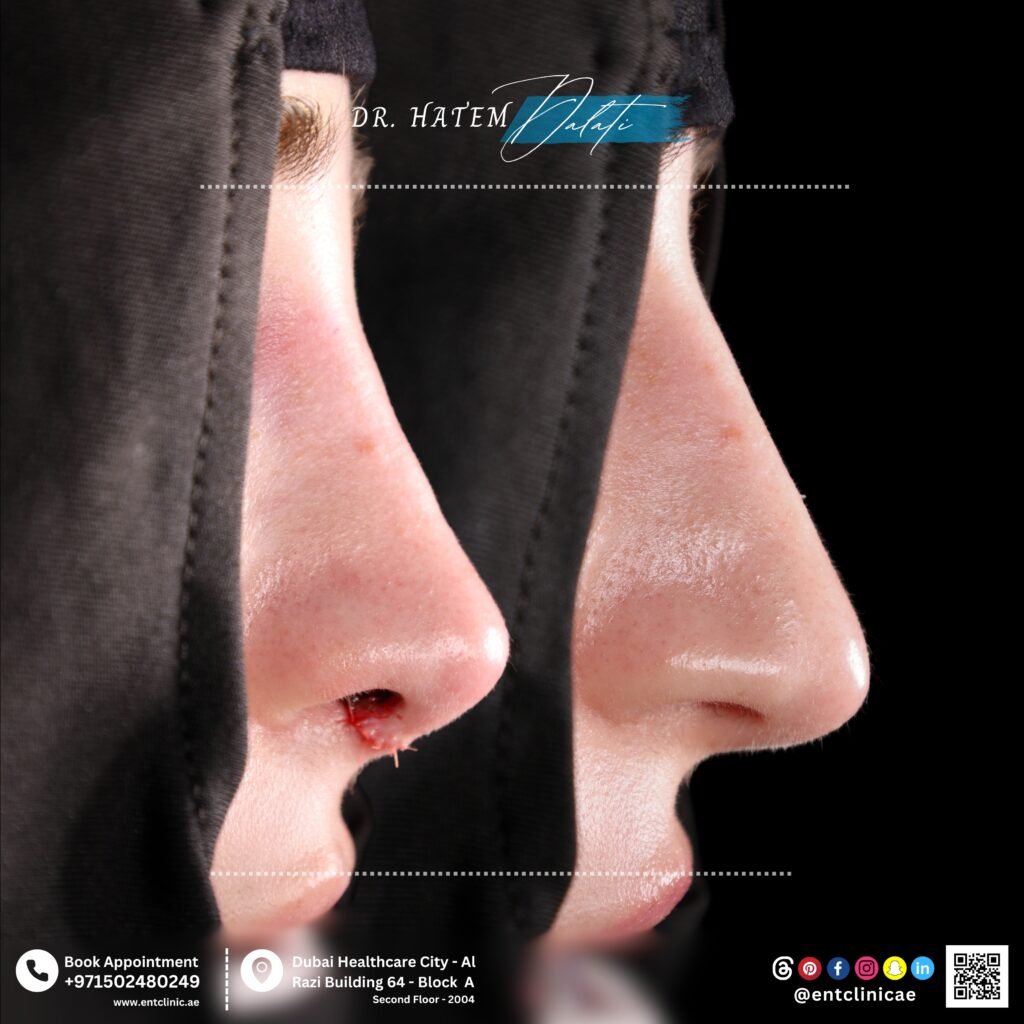
What Is Nasal Valve Collapse and Can Rhinoplasty Fix It?
Do you struggle to breathe through your nose—especially during exercise or sleep?
Do nasal strips, sprays, or allergy medications help only a little, or not at all?
You may be experiencing nasal valve collapse, one of the most common but often overlooked causes of chronic nasal obstruction. At the ENT Clinic of Excellence in Dubai, our expert ENT surgeon Dr. Hatem Dalati specializes in functional rhinoplasty—a procedure designed to restore your nasal airflow, strengthen weak cartilage, and help you breathe freely again.
What Is Nasal Valve Collapse?
The nasal valve is the narrowest and most critical part of the nasal airway — responsible for regulating around 70% of airflow. It acts as a gateway that controls how much air can flow into your lungs.
When this valve weakens or collapses—either internally or externally—airflow becomes restricted.
Common Symptoms:
- Difficulty breathing through the nose
- Symptoms that worsen during exercise or at night
- Improvement when pulling your cheeks sideways (Cottle maneuver)
- Whistling sound when breathing
- Chronic congestion without sinus infection
- Mouth breathing
- Fatigue due to poor sleep or reduced oxygen flow
What Is the Cottle Maneuver?
The Cottle Maneuver is a simple clinical test used to identify nasal valve collapse. During the test, the cheek is gently pulled outward to widen the nasal valve. If breathing improves, it indicates internal nasal valve obstruction. This test is widely used in ENT practices for evaluating airflow restriction.
Reference: Cleveland Clinic – Nasal Valve Collapse
What Causes Nasal Valve Collapse?
Nasal valve collapse can develop due to:
- Previous rhinoplasty (over-reduction of cartilage)
- Nasal trauma or fractures
- Deviated Septum
- Aging and weakened nasal cartilage
- Congenital structural weakness
Dr. Hatem will assess the exact cause using advanced diagnostics such as nasal endoscopy, airflow analysis, and imaging.
How Functional Rhinoplasty Fixes Nasal Valve Collapse
Rhinoplasty for nasal valve collapse focuses on strengthening and widening the valve area to restore proper airflow.
Common techniques include:
- Spreader grafts – widen the internal nasal valve
- Alar batten grafts – strengthen the sidewalls
- Septoplasty + rhinoplasty – correct structural deviations
- Cartilage grafting from the septum or ear for support
Unlike cosmetic rhinoplasty alone, functional rhinoplasty addresses both breathing and appearance, providing long-term, natural results.
Is Nasal Valve Collapse the Same as a Deviated Septum?
Not exactly—but they often occur together.
A deviated septum narrows one side of the nasal airway, and the added weakness of a collapsing nasal valve makes breathing even worse.
Combining septoplasty with valve repair often provides the best outcome.
For more information, you may also read:
👉 Rhinoplasty for Nasal Deformities & Fractures in Dubai | Restoring Nose Shape & Breathing Function
Why Patients Choose Dr. Hatem Dalati for Rhinoplasty in Dubai
- Highly experienced ENT & Rhinoplasty Surgeon specializing in cosmetic and functional nasal surgery
- Comprehensive nasal assessment using nasal endoscopy and airflow analysis
- Customized surgical planning based on facial harmony and individual breathing needs
- Refined surgical techniques for natural-looking, stable, long-term results
- Dedicated post-operative care ensuring smooth recovery and satisfaction
Learn more about Dr. Hatem’s expertise:
👉 Why Dr. Hatem Dalati Is the Best Choice for Rhinoplasty in Dubai
When to Consider Rhinoplasty for Nasal Valve Collapse
You may be a good candidate if:
- You struggle with chronic nasal obstruction
- Your symptoms worsen during exercise or while lying down
- You feel relief when manually lifting the nasal sidewalls
- You previously had rhinoplasty and now experience breathing issues
- You want to improve both breathing and nose shape
If you want to improve both breathing and nose shape, you may benefit from surgery. Find out which approach is best for you in our article: What Type of Rhinoplasty Do I Need?.”
Frequently Asked Questions (FAQs)
1. What is the main cause of nasal valve collapse?
The most common cause is weak or insufficient cartilage in the nasal sidewalls. It can also happen after trauma, previous rhinoplasty, a deviated septum, or natural aging.
2. Can nasal valve collapse be fixed without surgery?
Non-surgical options like nasal strips or dilators may offer temporary relief, but they do not correct the underlying structural weakness.
Functional rhinoplasty is the only long-term solution.
3. Does rhinoplasty always fix breathing problems?
Only if the breathing issue is caused by structural problems such as a deviated septum, enlarged turbinates, or nasal valve collapse.
A specialist ENT rhinoplasty surgeon like Dr. Hatem Dalati can diagnose the real cause using nasal endoscopy.
4. Is nasal valve collapse painful?
The condition itself is not painful, but it causes chronic breathing difficulty, which may lead to fatigue, sleep problems, or mouth breathing.
5. Can nasal valve collapse return after surgery?
With proper support grafts and a skilled surgeon, recurrence is very rare. Stability depends on surgical technique and strong cartilage support.
6. How long is the recovery after nasal valve repair rhinoplasty?
Most patients resume normal activities within 7–10 days.
Breathing improvement continues over several weeks to months as swelling subsides.
7. Will fixing the nasal valve change the shape of my nose?
In many cases, yes — but subtly and naturally.
Strengthening the valve may slightly widen the bridge or improve symmetry, leading to a more balanced appearance.
8. Is nasal valve collapse common after rhinoplasty?
Yes. If too much cartilage was removed in a previous nose job, the valve may weaken, causing collapse.
Revision rhinoplasty can restore breathing and structure.
9. Can I combine nasal valve repair with cosmetic rhinoplasty?
Absolutely — this is very common.
Functional and cosmetic corrections are often performed together to enhance breathing and aesthetics in one surgery.
10. How do I know if I have nasal valve collapse or a deviated septum?
Only an ENT specialist can confirm using a nasal exam and endoscopy.
Both conditions can occur together and may require a combined approach for full relief.
📞 Book Your Rhinoplasty Consultation in Dubai Today
If you’re tired of constant nasal blockage, poor sleep, or difficulty breathing, functional rhinoplasty may be the solution that finally brings relief.
Breathe better. Sleep better. Live better.
📞 Call/WhatsApp: +971 50 248 0249 (WhatsApp)
🌐 Website: www.entclinic.ae
📍 Location: Dubai Healthcare City
📲 Follow us for expert rhinoplasty insights: Instagram | TikTok | YouTube