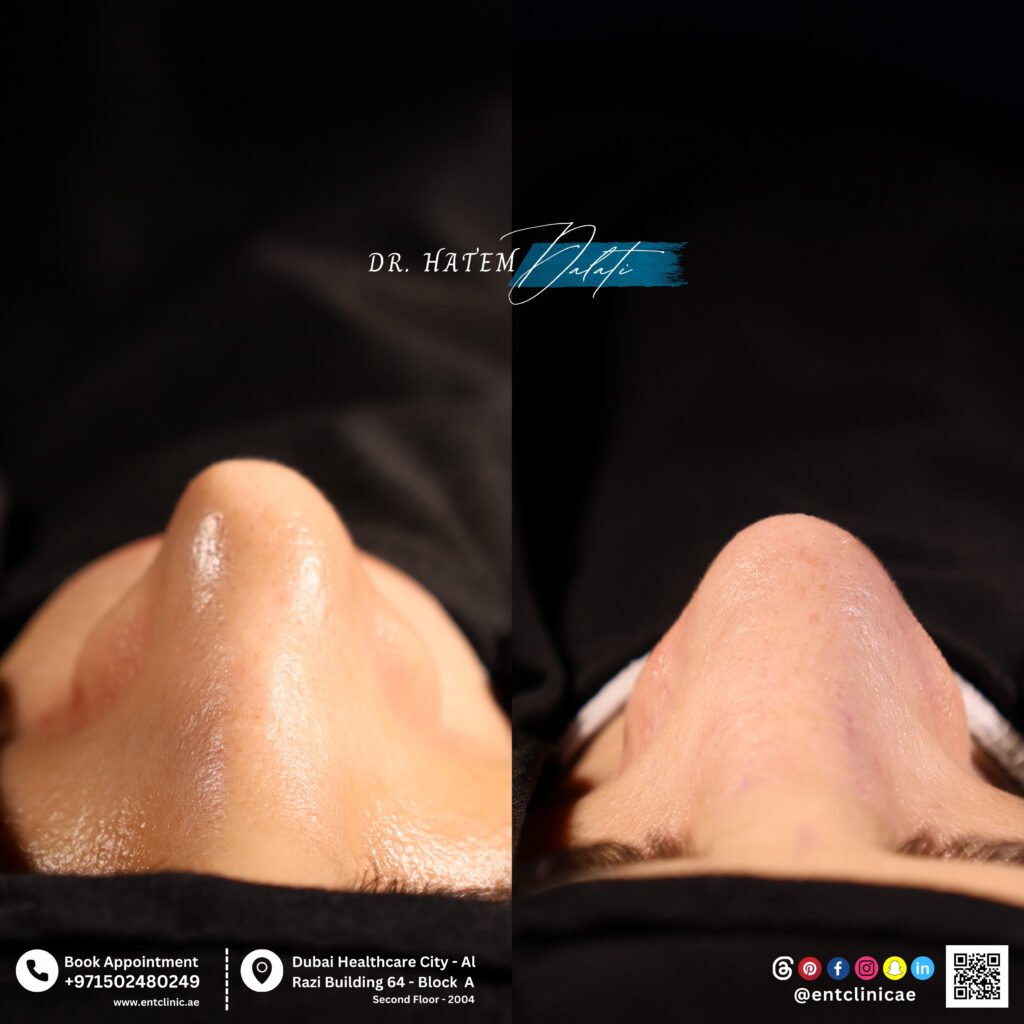
Are Silicone or Gore-Tex Implants Safe for Rhinoplasty? Risks, Rejection & Natural Cartilage in Dubai
Expert Insight from the Best ENT Clinic in Dubai
Rhinoplasty is a popular facial surgery that can enhance the appearance of the nose and improve breathing. While techniques have advanced, the type of material used inside the nose plays a critical role in long-term safety, stability, and patient satisfaction.
Synthetic nasal implants such as silicone and Gore-Tex (ePTFE) are still used in some regions to augment the nasal bridge or enhance projection. Although these materials may provide immediate aesthetic results, studies show they carry higher risks of infection, extrusion, and revision compared with natural tissue grafts.
A review published on PubMed, the U.S. National Library of Medicine’s biomedical database, confirms that autologous cartilage grafts are considered the gold standard in rhinoplasty due to their biocompatibility and lower long-term complication rates, while synthetic implants carry additional risks—especially in revision and complex nasal surgeries.
🔗 PubMed – Surgical Nasal Implants: Indications and Risks
At ENT Clinic of Excellence, a trusted destination for rhinoplasty in Dubai, we take a conservative, evidence-based, and ethical approach. We do not use silicone or Gore-Tex implants. Instead, we specialize exclusively in natural cartilage rhinoplasty, prioritizing patient safety, functional integrity, and results that age naturally over time.
This article explains:
- What silicone and Gore-Tex implants are
- Why implant rejection occurs
- The early warning signs patients should never ignore
- Why synthetic implants frequently fail long term
- Why natural cartilage is the safest option for rhinoplasty in Dubai
Understanding Silicone and Gore-Tex Implants in Rhinoplasty
Silicone Implants
Silicone implants are solid, pre-shaped synthetic materials traditionally used to elevate the nasal bridge. While they can initially create a smooth profile, silicone does not integrate with surrounding nasal tissues. Instead, the body forms a capsule around the implant, increasing the risk of:
- Chronic inflammation
- Implant movement or extrusion
- Infection
- Skin thinning
- Long-term rejection
These risks are particularly high in patients with thin nasal skin, weak cartilage support, or a history of previous nasal surgery.
Gore-Tex (ePTFE) Implants
Gore-Tex, or expanded polytetrafluoroethylene (ePTFE), is a porous synthetic implant designed to allow limited tissue ingrowth. Because it feels softer than silicone, some surgeons use it for nasal bridge augmentation or revision rhinoplasty.
However, Gore-Tex remains a foreign material. Once tissue grows into it, removal becomes extremely difficult. If infection or inflammation develops, surrounding nasal structures may be compromised during removal—often leading to complex reconstruction.
In hot, humid climates like Dubai, the risk of infection and delayed healing is significantly higher, making Gore-Tex an unfavorable choice for long-term nasal health.
Early Warning Signs of Implant Rejection After Rhinoplasty
Implant rejection does not always happen immediately. Many patients feel fine for months or even years before symptoms appear.
⚠️ Warning signs you should never ignore include:
- Persistent redness and swelling that does not resolve
- Ongoing pain or tenderness long after surgery
- Pus, discharge, foul odor, or fever
- Skin thinning with visible implant edges
- Implant shifting, asymmetry, or nasal deformity
When these signs appear, patients often require revision rhinoplasty in Dubai, which is far more complex than a first-time procedure.
Why Do Silicone and Gore-Tex Implants Fail?
Implant rejection and complications occur due to several interrelated factors:
Foreign Body Immune Response
The immune system may recognize silicone or Gore-Tex as foreign, triggering chronic inflammation.
Infection and Biofilm Formation
Bacteria can adhere to implant surfaces, forming biofilms that are resistant to antibiotics.
Improper Implant Size or Placement
Oversized implants increase pressure on the skin, reducing blood supply and raising the risk of extrusion.
Thin Nasal Skin
Thin skin cannot adequately camouflage implants, increasing visibility and skin breakdown.
Environmental Factors
According to global ENT guidelines, foreign implants have higher complication rates in environments with heat, humidity, and sweating—conditions common in Dubai.
Long-Term Risks of Synthetic Nasal Implants
While implants may look successful in the early months, long-term outcomes often reveal complications such as:
❌ Chronic infection
❌ Implant migration or extrusion
❌ Visible or unnatural nasal contours
❌ Skin thinning and scarring
❌ Structural nasal weakness
❌ Need for revision rhinoplasty
Many patients seeking revision rhinoplasty come to us after experiencing problems caused by silicone or Gore-Tex implants placed elsewhere.
How Implant Rejection Is Managed In ENT Clinic of Excellence
Early-Stage Implant Complications
- Antibiotics or corticosteroids
- Close monitoring by our experienced ENT surgeon
- Temporary symptom relief only
Advanced or Late-Stage Rejection
- Complete implant removal
- Revision rhinoplasty using cartilage grafts to rebuild structure
Once rejection begins, retaining the implant is rarely safe.
Gore-Tex vs Natural Cartilage: A Clinical Comparison
Synthetic Implants (Silicone / Gore-Tex)
- Foreign material
- Higher infection risk
- Can shift or extrude
- Do not age naturally
- Often require revision surgery
Natural Cartilage Rhinoplasty
- 100% biocompatible
- Integrates with nasal tissues
- Lower infection risk
- Strong structural support
- Long-term stability and natural aging
From both functional and aesthetic perspectives, natural cartilage is the safer and more durable option.
Why We Use Natural Cartilage Only at ENT Clinic of Excellence
As a leading ENT and rhinoplasty clinic in Dubai, our philosophy is simple:
Do not introduce unnecessary risk into a healthy nose.
We exclusively use:
- Autologous cartilage (from the septum, ear, or rib)
- DHA-approved donor cartilage when necessary
💚 Advantages of cartilage-based rhinoplasty:
- No immune rejection
- Excellent healing
- Strong nasal framework
- Natural look and feel
- Improved breathing outcomes
Learn more here:
👉 Will I Need Cartilage Grafts for My Rhinoplasty, and Where Are They Taken From?
Functional Benefits of Cartilage Rhinoplasty
Natural cartilage is not only safer—it is functionally superior. It is ideal for:
- Functional rhinoplasty
- Septoplasty in Dubai
- Deviated septum correction
- Nasal valve collapse
- Trauma and fractures
By reinforcing the nasal structure, cartilage grafts improve airflow and long-term breathing.
Who Is the Best Candidate for Natural Cartilage Rhinoplasty?
This approach is especially recommended for patients seeking:
- First-time rhinoplasty in Dubai
- Revision rhinoplasty after failed implants
- Breathing improvement
- Long-term safety and durability
- Natural, non-artificial results
Why Patients in Dubai Choose ENT Clinic of Excellence for Natural Rhinoplasty
Choosing a rhinoplasty surgeon in Dubai requires expertise, ethics, and an understanding of nasal function. At ENT Clinic of Excellence, we focus on both appearance and breathing health with a patient-centered, ENT-based approach.
All procedures are performed by Dr. Hatem Dalati, a board-certified ENT and rhinoplasty surgeon in Dubai, experienced in cosmetic, functional, and revision rhinoplasty. Our clinic follows internationally accepted surgical standards tailored to each patient’s anatomy.
Learn more about our surgeon’s experience:
👉 Why Dr. Hatem Dalati Is the Best Choice for Rhinoplasty in Dubai
Our Standards:
✔ No silicone or Gore-Tex implants
✔ Personalized surgical planning
✔ Expertise in complex revisions
✔ Full care from consultation to recovery
✔ Located in Dubai Healthcare City
Patients across Dubai and the UAE trust us for safe, natural, and long-lasting rhinoplasty results.
FAQs
Is silicone implant rejection common after rhinoplasty?
Silicone implant rejection is uncommon but serious. When it occurs, it may cause infection, implant exposure, or nasal deformity, often requiring implant removal and revision rhinoplasty.
Is Gore-Tex safer than silicone for rhinoplasty?
Gore-Tex is softer than silicone but remains a synthetic material. It still carries risks such as infection, extrusion, and difficult removal, particularly in warm climates.
Why do ENT surgeons avoid nasal implants?
Many experienced ENT surgeons avoid implants because they increase long-term risks such as infection, rejection, and the need for revision surgery.
What is the safest material for rhinoplasty?
Autologous cartilage is considered the safest material. It is biocompatible, integrates naturally, and provides long-term structural support.
Can implant complications require revision rhinoplasty?
Yes. Implant-related complications often require implant removal and revision rhinoplasty, which is more complex than primary surgery.
Does cartilage rhinoplasty improve breathing?
Yes. Cartilage grafts strengthen nasal support and can significantly improve airflow and breathing.
Is natural cartilage rhinoplasty permanent?
Natural cartilage provides long-term stability and ages naturally with the face.
Book a Consultation with Dubai’s Trusted ENT & Rhinoplasty Clinic
If you are experiencing implant-related complications—or want a safer, natural approach to rhinoplasty—we are here to help.
📍 ENT Clinic of Excellence – Dubai Healthcare City
👨⚕️ Dr. Hatem Dalati | ENT Consultant & Rhinoplasty Surgeon
📞 WhatsApp: https://wa.me/971502480249
🌐 Website: https://entclinic.ae
📱 Follow us for expert ENT & Rhinoplasty education:
Instagram | YouTube | TikTok
✨ Rhinoplasty should never compromise your health. Choose natural cartilage, expert care, and results that last.
I found your weblog website on google and examine a couple of of your early posts. Continue to keep up the very good operate. I simply additional up your RSS feed to my MSN Information Reader. Looking for forward to reading more from you later on!?
Hello there, simply became aware of your weblog through Google, and found that it is truly informative. I抦 gonna watch out for brussels. I抣l appreciate for those who proceed this in future. Numerous other people will likely be benefited from your writing. Cheers!
Thank you for writing this post. I like the subject too. http://www.ifashionstyles.com
whoah this blog is magnificent i love reading your posts. Keep up the great work! You know, lots of people are looking around for this information, you can help them greatly.
Thanks for the article, can you make it so I receive an alert email when you publish a new post?