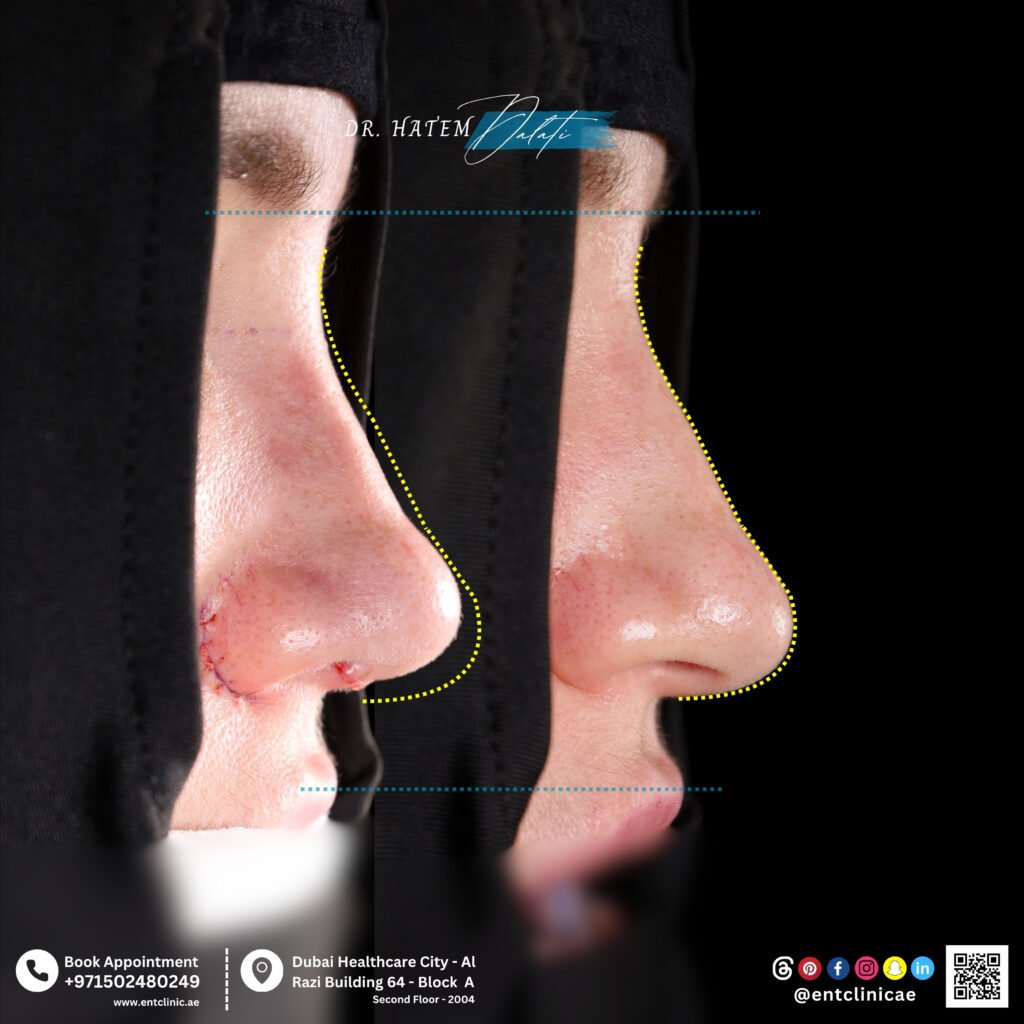
How Is Rhinoplasty Performed? A Step-by-Step Guide by Dr. Hatem Dalati
If you’re considering rhinoplasty in Dubai, understanding the process can help you feel more confident and prepared. Rhinoplasty is one of the most precise facial surgeries, combining both artistic vision and surgical expertise to enhance facial harmony while maintaining natural results.
At the ENT Clinic of Excellence in Dubai Healthcare City, Dr. Hatem Dalati, an experienced ENT and rhinoplasty surgeon, performs highly customized procedures designed to improve both cosmetic appearance and nasal function.
This guide explains exactly how nose surgery in Dubai is performed step by step, what to expect, and how results are achieved safely and naturally.
Step 1: Consultation and Surgical Planning
Your nose susrsgery journey begins with a detailed consultation. Dr. Hatem Dalati carefully evaluates your:
- Nasal anatomy
- Facial balance and proportions
- Breathing function
- Skin thickness and cartilage strength
- Personal aesthetic goals
Instead of relying on computer simulations, Dr. Dalati uses a surgeon-led anatomical planning approach. He studies a detailed nasal diagram and marks planned modifications such as:
- Bridge refinement
- Tip reshaping
- Nasal symmetry correction
- Airway improvement
This transparent planning method helps patients clearly understand the surgical plan, improving trust and confidence before surgery.
Who Is a Good Candidate for Rhinoplasty?
You may benefit from nose surgery if you experience:
- A nasal hump or asymmetry
- Breathing difficulties due to structural issues
- Droopy or bulbous nasal tip
- Previous unsatisfactory nose surgery
- Desire for improved facial harmony
Step 2: Administering Anesthesia
For patient comfort and safety, Dr. Hatem Dalati performs rhinoplasty under general anesthesia. This ensures you remain fully asleep and pain-free throughout the procedure, allowing for maximum precision and comfort.
An experienced anesthesia team closely monitors you during the entire operation to ensure maximum safety and stability.
Step 3: Making the Incisions
Dr. Hatem performs either an open or closed rhinoplasty technique depending on the complexity of the case:
- Open Rhinoplasty: Involves a small incision across the columella (the tissue between the nostrils). This approach provides full visibility of the nasal structures and is commonly used for complex, revision, or functional cases.
- Closed Rhinoplasty: Incisions are hidden inside the nostrils, making it ideal for patients requiring minor adjustments and quicker recovery.
The choice of technique depends on your anatomy and the goals of your surgery. You can learn more about which approach may be right for you in our guide: What Type of Rhinoplasty Do I Need? Expert Guide from Dubai’s Best Rhinoplasty Surgeon.
Step 4: Reshaping the Nasal Structure
Once access is achieved, Dr. Dalati carefully reshapes the bone and cartilage structure of the nose. This may include:
- Removing or smoothing a nasal hump
- Narrowing wide nasal bones
- Straightening a deviated septum
- Adding cartilage grafts for support
This stage is essential for achieving both aesthetic refinement and functional breathing improvement, especially in cases of functional nose surgery in Dubai.
Cartilage Grafting in Nose Surgery
In some cases, cartilage grafts are used to strengthen or refine the nose. These may come from:
- Septal cartilage (inside the nose)
- Ear cartilage
- Rib cartilage (for complex reconstruction)
Grafting ensures long-term structural stability and natural contouring, especially in revision cases
Step 5: Refining the Nasal Tip
The nasal tip is one of the most delicate and artistic aspects of a nose job.
Dr. Hatem Dalati skillfully refines the tip cartilage to improve shape, projection, and symmetry while maintaining a natural, non-operated look.
Whether your goal is a softer, more defined tip or subtle correction of asymmetry, this step ensures the nose harmonizes with your other facial features.
Step 6: Closing the Incisions
After the reshaping and refinement are complete, the incisions are meticulously closed using fine sutures.
Dr. Dalati ensures minimal scarring—especially for open nose surgery patients. The sutures are placed carefully to support optimal healing and long-term cosmetic results.
Step 7: Splinting and Immediate Aftercare
A small nasal splint is applied to protect and support the new nasal structure during early healing.
In some cases, internal splints may also be placed to stabilize the septum, especially if a septoplasty was performed.
You will be monitored in recovery before being discharged with detailed aftercare instructions, including:
- How to manage swelling
- Cleaning guidelines
- Activity restrictions
- Medication plan
Types of Nose Job We Offer in Dubai
At the ENT Clinic of Excellence, we offer tailored nose surgery options depending on your aesthetic and functional goals:
- Aesthetic Rhinoplasty – For a more refined, symmetrical look.
- Functional Rhinoplasty – To correct breathing problems and improve airflow.
- Ethnic Rhinoplasty – Enhancing natural features while maintaining cultural identity.
- Revision Rhinoplasty – Correcting or improving results from previous surgery.
Real Patient Results: Functional and Revision


Why Choose Dr. Hatem Dalati for your Nose Job in Dubai?
- Expert in both cosmetic and functional nose surgery
- Customized, anatomy-based approach—each surgery is tailored to your unique facial features and nasal structure for natural, personalized results
- Extensive experience in revision and complex nasal surgeries
- Trusted by patients in Dubai Healthcare City and across the UAE
Whether you’re seeking subtle refinement or major correction, Dr. Dalati’s goal is to enhance your natural beauty and breathing function safely.
❓ Frequently Asked Questions About Nose Job in Dubai
1. How long does a nose job take?
For Dr. Hatem Dalati, rhinoplasty surgery typically takes 3 to 4 hours, though revision rhinoplasty may take longer depending on the complexity.
2. Will I have visible scars after a nose job?
In open rhinoplasty, a tiny incision is made across the columella, which usually heals to a nearly invisible line. Closed rhinoplasty leaves no external scars since all incisions are made inside the nostrils.
3. When can I return to work after a nose job?
Most patients can return to work after 7 to 10 days, once the splint is removed and swelling has decreased. However, complete healing and final results take a few months.
4. Is rhinoplasty painful?
Rhinoplasty is not typically painful. You may feel mild discomfort or pressure for the first few days, which can be easily managed with prescribed pain relief.
5. Can a nose job improve breathing problems?
Yes. Functional rhinoplasty can correct structural issues such as a deviated septum or enlarged turbinates, improving airflow and breathing comfort.
📍 Book Your Rhinoplasty Consultation in Dubai Today
Transform your confidence with expert ENT and facial surgical care.
At the ENT Clinic of Excellence, Dubai Healthcare City, Dr. Hatem Dalati provides personalized rhinoplasty treatments designed to enhance both appearance and breathing function
📞 Contact Us on WhatsApp: https://wa.me/971502480249
📍 Location: ENT Clinic of Excellence, Dubai Healthcare City
🌐 Website: x-pay.in
📱 Follow us: Instagram Tiktok
👉 Take the first step toward a more balanced, confident version of yourself with expert nose job in Dubai.